

27 March 2026
Stories from Kurdistan – Life in the Shadow of War
Soma Negahdarinia
This is a collection of accounts from different cities in Kurdistan. With the internet and phone lines cut, it has been difficult to reach people in Iran. Still, I have tried to speak with as many people as I could, through friends, and sometimes even strangers I came across by chance. Some of these accounts come from direct conversations, others were messages passed along through someone else. I’ve just written them up, as they are, without adding anything.
I want to go back now to March 3rd—the fourth day of the war—and begin with my own story.
My account
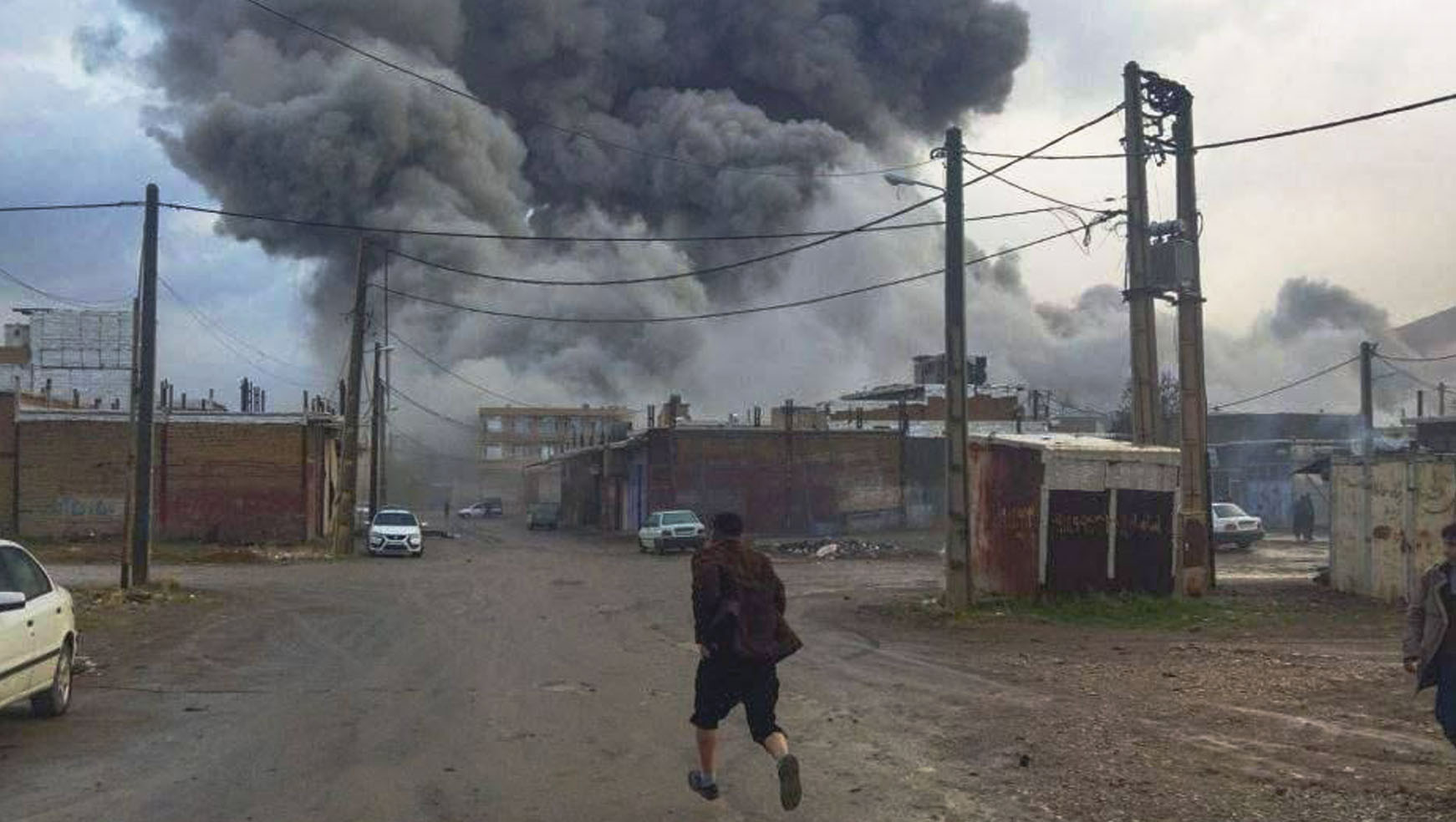
It was March 3rd. American and Israeli attacks on cities in Kurdistan were at their height. Around noon, as I was carefully following reports about the bombing of neighbourhoods in Sanandaj, I saw one report saying there had been a large explosion in the Takyeh and Chaman neighbourhood. From the location and the signs visible in the image, I could guess that the bomb had landed near my sister’s house.
Even now, as I write this, I cannot clearly remember my own physical reaction in those moments. I was confused. I could not breathe properly. My hands were shaking with anxiety. Given the number of people killed the day before in the bombing of Twenty-Five Street near the Sanandaj garrison, I expected the worst.
I called everyone I could think of. Everyone was worried, but no one had any details of what was happening. Then, after an hour and forty minutes, with the help of a journalist friend in Iran who had limited internet access, I finally managed to find out that a bomb had landed in the alley behind my sister’s home, many of the houses in both alleys had been damaged, and my mother and sister were injured and were in hospital.
That was all the information I got in a short call through my friend. I sat down on the floor, and for hours afterward there was a constant ringing in my ears, like a whistle.
A few days later, a voice message arrived from my mother. Very calmly, in a quiet voice, she told me that everyone was alright. She was clearly trying to be reassuring and hide any anxiety. They had been discharged from the hospital, and the family were all together at my parents’ house now, and there was no longer any problem. Behind my mother’s voice, I could hear my little niece singing, and I could hear a man laughing too, maybe my father.
I kept thinking about the sound of life. My mother said that the building’s corridors had collapsed, and even the potted plants were gone. I remembered a video my sister had sent months earlier—those plants had been lined up on the stairs. In the video, I saw her bookshelf near the entrance, right behind the corridor wall. I paused the video and looked at our family photos on the shelves. I imagined them now buried under rubble.
A few days later, more images of the destroyed neighbourhood appeared in the news. I didn’t know exactly which building was my sister’s—I had never seen her home in person—but from the photos and videos she had sent me over time, I could guess. It was probably the one whose balconies were still standing—but where the plants were gone
S, a young artist from Marivan
S. is a young woman from Marivan who works in the arts. She sent me her account in a message.
In the days before the bombing, there was already a heavy atmosphere of fear in the city. Security forces and riot police were stationed in all the main squares. It seemed like they were worried about protests, but nothing actually happened. People were still going about their lives.
But once the bombings began, everything changed. After the first strike—an afternoon attack on a Revolutionary Guard building—people became very frightened.
Those who could left the city for seasonal homes, gardens, or nearby villages. Others gathered in houses in safer neighbourhoods. But not everyone had that option.
Within just a few days, life shifted completely. For about two days, all the markets were were completely shut down - even small neighbourhood shops. A few bakeries stayed open, but by the second day there were long lines for bread and fuel. This lasted for the first four days, then things slowly started to calm down.
People cautiously returned to the streets. Some shops reopened, but most were still closed—especially those near military or government sites. Even a busy psychology clinic had to shut down because of its location.
Larger grocery stores are now open during the day, but everything closes before dark. The big market, once full of people and visitors, is now almost empty. There’s no traffic anymore. People only leave home for essential needs.
Economic pressure is getting worse. Even people who used to be doing okay are now struggling. Everyone is trying to use their supplies carefully.
Online businesses have basically stopped. Many were run by women who sold handmade goods. Young shopkeepers who invested everything in cross-border goods are now out of work, with no clear future.
Many people, both men and women, in border areas survive through kulbari, carrying goods on their backs, across the border. But now even that has stopped. because the government is constantly threatening people in the border regions.
As we approached Nowruz and Ramadan, the city didn't feel the same. There was none of the busy shopping or celebration. A few shops had simple, cheap New Year items outside, but that was it.
People are preparing for harder days ahead. They’re stocking up on essentials—just in case. People are bracing themselves for days when the electricity may be cut, or the water, or the gas. Pharmacies are crowded. People are trying to store medicine. Parents are buying baby formula and diapers. Prices have doubled. Anxiety medications are scarce and rationed. There’s still food and bread, but prices have gone up. Rumours say shops can’t restock and supplies are running out. Cash is rare. People are saving it. ATMs are empty. Most transactions are digital now.
Military and security buildings have mostly been destroyed, and security forces are now stationed in public areas. Sometimes residents protest when they try to move into neighbourhoods.
A few nights ago, residents in a neighbourhood discovered military forces attempting to move equipment into a local sports hall to station themselves there. Word spread quickly, and people gathered around the building to block access. Even individuals who would not usually protest joined in, fearing their neighbourhood might be bombed if security forces were stationed there. The crowd refused to disperse until the forces completely withdrew.
In another neighbourhood, security forces tried to station themselves inside a mosque, but local residents and the cleric opposed the move and successfully prevented it.
Many people are afraid that if the war continues and armed Kurdish groups return, the government will use that as an excuse to bomb the cities again. Of course, some people support the return of the Kurdish forces, and there are heated arguments between those who agree and those who disagree.
But one thing is clear: people feel their lives are being held hostage by this government. And especially older Kurds, who remember the wars in Kurdistan in the early years after the revolution, are most afraid that we may be dragged back into those days again.
M, a former political prisoner from Sardasht
M. believes Kurdish groups should return and finish what was left unfinished decades ago.
“What we wanted back then wasn’t wrong—we wanted democracy for all of Iran. But the government treated it like a crime and declared jihad against us. For years, they labelled us as separatists to justify killing us.
Forty years later, they used the same lies to kill protesters across the country. People need to free themselves from these lies. This is a unique opportunity for Kurdish parties and other groups in Iran to unite and get rid of this government. I think that out of this war, and out of all these years of suffocation, people will learn how to speak to one another and find understanding. It won’t be easy. Many will suffer. But freedom has a price—maybe higher than anything we’ve paid so far.”
D, a self-employed man from Kermanshah
D. is a self-employed man. He describes a city that has become deeply tense and controlled.
After the killings on January 8th and 9th, the atmosphere in Kermanshah had become very radical. People were angry and divided. Some wanted the government gone at any cost. Arguments were intense—even between friends and family. When the war began, those divisions faded. In the first days, the bombing of Kermanshah was very extensive, because Kermanshah and the surrounding towns are the most militarized in Kurdistan
At first, people even felt hopeful, thinking the government might fall. But as time passed and nothing changed, fear returned. Security forces are everywhere now - armed, in plain clothes, in unmarked cars. Checkpoints are everywhere. Gunfire is heard regularly.
The city feels suffocating. People are afraid. “The main issue is this,” he says. “They have weapons. We don’t.”
N, a student from Sanandaj
N is a student who has had full access to the internet during the blackout. In her account, she talks about the internet shutdown and the way people shared news in the city, though she does not explain how she herself had access herself.
With communication cut off, people abroad were desperate for news from inside Iran. Since she had internet access, she became a link between families.
"Some members of my own family also live outside Iran, and because they knew I had access to the global internet, they would sometimes connect their worried friends to me so I could help them get news of their families’ safety. At times, I felt like I was in a World War II movie, secretly passing messages. But most of the messages were just simple family check-ins. Once, I even informed an aunt in Germany that her sister had given birth. Of course, there were also messages about damaged homes, injured family members. Thank God, though, I never had to carry the news of someone’s death.
Misinformation was everywhere. "One night, I received a message from a desperate Sanandaj woman living abroad, begging me to contact her family because she had seen reports saying their neighbourhood had been bombed and more than five hundred people had been killed. I panicked, but when I contacted her family, it turned out to be false - there had been no bombing at all in their area. There were many incidents like this, where wrong or incomplete information was circulated and created a terrifying picture of events.
I have stayed online so far by being very cautious, but I can't be sure how long I will last. I too may disappear into the silence inside Iran.
M, a woman from Paveh
M is a woman, who lives in one of the border villages between Iraqi Kurdistan and Paveh. Her family are connected with the government. Soon after the war began, she left with a group of relatives and crossed to the other side of the Kurdistan border in Iraq, and they are all now living in relatives’ homes. She speaks about her fears.
I was born into a very religious family. My father worked with the government from the early years after the revolution, and later both of my brothers also joined circles close to the government. But I always kept my distance from politics. Even when choosing a husband, I tried to marry someone who was not political and not connected to the government. Even so, in the current atmosphere, my older brother quickly sent me and the other women in the family out of the city because he was afraid that, if the government were weakened, some anti-government groups might seek revenge.
I completely understand why people who have lived for years under oppression and injustice by this government might want revenge. But not everyone should be treated the same way. The wives and children of government officials are not guilty in all this. Now we are afraid, and we do not even know that if things calm down, whether we will be able to return to our old life, or whether we will have to leave our city forever.
S, a teacher from Saqqez
S, a teacher, describes local community organizing.
Since the war began, groups of trusted residents have been meeting at night to prepare for crisis scenarios—shortages, insecurity, breakdown of order.
We’ve made plans for rationing and distributing food, fuel, and medicine, and for protecting neighbourhoods if needed.
We have made plans for how, in the event of disorder, we can use volunteer forces in the city to help protect people’s safety. We are preparing ourselves for the worst possible conditions while still hoping that such a situation never comes. Years ago, we experienced dark days under this government, when it used military lockdowns of the city. But now we are using what we learned from those experiences, to protect people. And all of this planning is completely rooted in the community, and we have no connection to the Kurdish parties. They are probably organizing themselves in their own way too, but we know nothing about that.
R, a mother from Sanandaj
R. is a woman from Sanandaj who gave birth on the second day of the bombing. The day before, on her doctor’s advice, she had gone to Qorveh to give birth in safer conditions.
On the morning the bombing began, the number of dead and wounded was very high, and the atmosphere in Sanandaj’s hospitals had become extremely tense. The maternity ward was still functioning, but on my doctor’s advice I went to Qorveh. I knew the facilities there were more limited, but I could not bear the anxiety of giving birth under bombardment.
The doctor and nurses quickly completed my admission, and another doctor took over my care. Childbirth is difficult in itself, but my anxiety went beyond that. Every moment I felt a bomb might fall on the hospital. At the same time, I was thinking about my family back in the city. It felt like a nightmare, until my baby was born and I held him in my arms. For a few moments, I looked at his crying face and cried with him.
I had mixed feelings. I was happy to be holding my son, grateful that we were both alive, but I kept wondering what would happen to us - whether I could protect him, whether we will be displaced by the war. I asked a nurse if these fears were excessive. She smiled and said it was instinctive, that all mothers think this way.
Now I try to think about better days, about the future that may still await the next generation. Right there in the hospital, the nurses suggested I name my son Hiwa - a Kurdish name meaning “hope.” My husband and I had chosen another name, but we decided to call him Hiwa instead.
Our Hiwa, for the future.
B, a women’s rights activist in Sanandaj
B has worked for years on issues of domestic violence. Now, in wartime, her concerns have grown.
Since the beginning of the war, many families have been displaced within the city itself. Some have lost their homes to bombing; others, living near military or security sites, have been forced to leave. They move constantly between relatives’ and friends’ houses. In these conditions, women and children are the most vulnerable to domestic violence and sexual assault - one of our main concerns in recent days.
Despite everything, we have tried to keep our care networks active. After the global internet was cut, we created pages on domestic platforms and shared information on protecting women and children in crisis conditions. Even under constant government pressure, we have kept the focus on helping people so as not to expose anyone to further risk. Volunteer groups have supported elderly people, children, and mothers, providing medicine and basic supplies, and helping them move to safer places.
We have also stayed in contact with women’s and maternity wards. Although parts of Sanandaj’s hospitals were evacuated and security controls were imposed, disrupting services for a time, they are now functioning again. Paediatric wards, special disease units, and dialysis centres are still operating - though in unsafe conditions and with no clear outlook.
We have also continued our reading circles and discussion groups, trying to care for ourselves during the crisis. We refuse to let the macho atmosphere of war marginalise us and push us out of action. We are trying, in whatever ways we can, to preserve our agency and remain visible.
In recent months, many people - even friends and colleagues - have told us that the Woman, Life, Freedom movement is over, and that women must adapt to new ways. For us, this has been a warning. It shows how easily women can be ignored or erased, especially in times of war and repression. History has shown this again and again.
But we have stayed put. Even in these conditions, we continue to defend the rights of women, children, and those in need. We defend the right to life and the dignity of citizens, as we have always done.