

17 February 2026
One Hundred Dead in a Small Hospital: A Nurse’s Account from Qarchak
Sahar Keramat
By late Friday, the morgue was full.
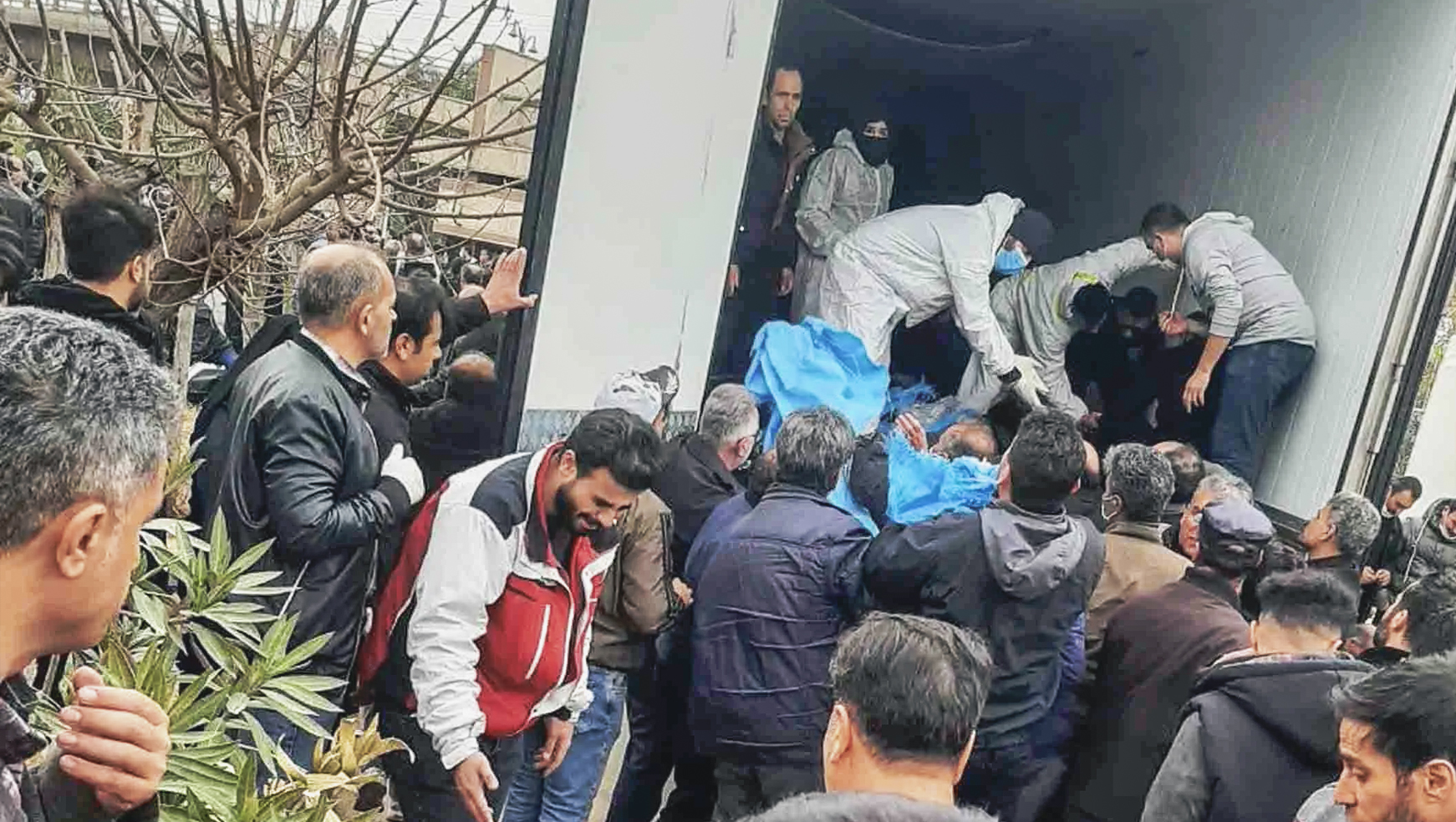
“We had no choice,” Ahmad says. “We moved the bodies to the dialysis ward and laid them side by side. We even ran out of body bags. We wrapped them in sheets and tied the ends.”
Ahmad is a nurse in Qarchak, a small city in Tehran province with a population of less than 270,000. For his safety, we are using a pseudonym. In just two nights (Thursday and Friday the 8th and 9th January) at least one hundred people were registered as dead in the small medical centre where he works.
On Thursday night alone, he says, nearly forty bodies were brought in — people who had died before reaching the hospital. “There was nothing we could do for them,” he recalls. “For a city the size of Qarchak, that number is a catastrophe.”
Others arrived alive but gravely wounded. Many were sent to the ICU; many did not survive. Around twenty were transferred to hospitals in Tehran. “Most of them died too. Their injuries were too severe.” Some had been struck by pellet guns. Others by live ammunition. By Ahmad’s estimate, the death toll in those two days easily reached one hundred — and that includes only those who made it to the hospital. “The next morning, bodies were found in the streets and in drainage ditches. Some were taken directly to the forensic centre in Kahrizak. There is no way to know the real number.”
Waiting for the inevitable
The hospital was on full alert, for Thursday and Friday. Ahmad says the atmosphere reminded him of a scene from The Lord of the Rings: The Two Towers — defenders lined up along the fortress walls, staring into the dark plain, knowing an attack was coming. “We discharged all non-emergency patients. We cleared out the emergency ward and doubled the nursing staff. We were waiting.”
At 8:15 p.m., the first patient arrived. A direct gunshot wound to the head.
After that, the stretchers came in a steady, unbroken line.
Those who showed no signs of life were taken to resuscitation, checked, placed in covers, and sent to the morgue. Those hit by pellets but still stable were treated in 'outpatient surgery". Others were moved to emergency care. “It didn’t stop,” Ahmad says. “We experienced something we had never seen before. Not in 2022. Not in 2019. Nothing like this. It was a mass killing.”
Shots to the head and chest
In the first three hours, most of the wounded had pellet injuries. But after around 10:30 p.m., the pattern changed. More and more patients arrived with live bullets lodged in their heads and chests.
“It felt as if snipers were positioned on rooftops,” Ahmad says quietly. “We could tell from the angle of entry.”
Nearly everyone shot in the head or chest was already dead by the time they reached the hospital. A few who were hit in the thigh, back, or arms had a chance. Some were treated and discharged. Others went into surgery. Many of those, too, later died.
Colleagues in Tehran hospitals told him their nights were even worse.
Roughly half of those who died in Qarchak were identified by family members who brought them in. The other half arrived unnamed. “At least fifty percent had no ID,” Ahmad says. “Families were shattered. They were screaming, hitting their heads and faces, arguing with security. We were losing control.”
Four days later, new patients began arriving — not from fresh gunfire, but with infected pellet wounds. Many had been too afraid to seek treatment that night. Some required surgery. Some died. “Even now,” Ahmad says, “there are people at home with pellets still inside their bodies. They are in pain and don’t know when — or if — they can go to a hospital.”
When asked whether security forces entered the hospital to finish off the wounded, Ahmad pauses. “They didn’t come to our centre. Maybe they were too busy in the streets. I believe this government is capable of anything. There are no red lines. But I also believe there are honourable people in the medical staff who would stand in their way.”
The search for the missing
By three or four in the morning on Saturday, families began arriving with photographs in their hands. They walked from desk to desk, asking if we had seen their son, their daughter, their husband. With no names to offer, staff directed them to the morgue for identification.
“It was unbearable,” Ahmad says.
The dead were young and old. Men and women. Teenagers. Children.
One of the youngest was a teenage boy who had gone out with his mother to shop. He was shot and killed in the street. A fifty-year-old man leaned out of his window to see what was happening below. He was shot in the head with pellets. “His skull was covered in small and large pellet marks,” Ahmad says. The family insisted on transferring him to a hospital in Tehran. “He had no chance.”
Hospitals under watch
During those days, the atmosphere inside hospitals changed.
Security forces were everywhere. “There were more security agents than doctors and nurses,” Ahmad says. They carried notepads, moving through corridors, entering rooms, asking questions. With every new patient, they demanded details: Was it a pellet wound? A bullet? What was the patient’s full name and national ID number?
“This never happens in normal times.”
For some patients who were treated and discharged, hospital staff deliberately altered records, listing symptoms as weakness, high blood pressure, or blood sugar fluctuations to shield them. Even so, Ahmad later heard that some received summons messages.
He estimates that 60 to 70 percent of the dead were men. Around 70 percent were between 25 and 40 years old.
“Our small centre recorded about one hundred deaths in two nights,” he says. “And that’s just us.”
Officials have cited nationwide figures of around three thousand. Ahmad calls such numbers meaningless. “If a small hospital like ours saw one hundred deaths, you can imagine the real total.”
Medical staff were warned not to document what they witnessed. In some hospitals, phones were confiscated. Nurses were explicitly told not to share information.
“All of us broke inside during those nights,” Ahmad says. “We could not record what we saw. But we cannot forget it.”