

10 June 2026
Writing women into the war narrative: state's preemptive historiographies
Bahar Saba
Absence of large segments of stories and histories of wars, even long after they end, is the norm rather than the exception. Parties to wars have historically maintained a tight grip over war narratives, and even when the power of states over these narratives and historiographies starts to erode, there remain other factors that hinder the emergence of alternative, pluralistic and previously absent narratives: trauma, shame, guilt, expectations to move on and rebuild what has been senselessly destroyed by violence, as well as patriotic and nationalist sentiments.
The Iran-Iraq War, as one of the longest and bloodiest conventional inter-state wars of the twentieth century, barely left any lives untouched. Yet, more than three decades on since the end of the conflict, war narratives, whether in the form of history, art, or literature, are characterized by the absence of remembering of the war, which retrieve and reflect people’s very diverse experiences and memories. Wartime experience of children, including child-soldiers, women of various backgrounds, ethnic and religious minorities and political dissidents – among many others - have remained largely missing. While, as in the case of other wars, a multitude of reasons including trauma could explain some of these absences, the policies of the Iranian authorities in maintaining hegemonic power over all war narratives, including through coercion and censorship, has been at the core of these glaring absences.
Since the start of the war, the Iranian authorities presented the conflict “not simply, or even primarily, as a question of territory, but rather as a challenge to [the Islamic Republic’s] very system.”[1] Maintaining hegemony over war narratives was thus pivotal for mobilisation of forces and legitimising wartime policies. Since then, memories and narratives of the war, referred to by the state as the ‘sacred defence’ , have remained an ideological pillar of governance by the Islamic Republic and vital to the state’s claim to political legitimacy and the ability to exert social control. The Iranian authorities have been well aware that the war, as any historical event, is laden with sites of contestation and that the absent voices of the war, if emerged, would not only present previously censored historical facts and truths about the loss and destruction and state’s policies and decisions, but can offer a radical potential to disrupt the singular narrative and truth presented by the state; open up space for reflection; change public attitudes towards wars; create new-found sympathies and ultimately open up a subversive space for resisting political and social domination.
Over the past decades, the strategies adopted by the Iranian authorities to maintain their hegemony and monopolise all discursive practices on the war have become increasingly intelligent. Instead of only and merely censoring and maintaining their discursive hegemony through coercion, they have resorted to more discreet strategies. One of these strategies, in my view, has been “preemptive historiographies.” The term “preemptive historiography” was coined by Erich Hahn, a historian, in description of Germany’s attempts at producing a historical narrative that refuted its responsibility for the outbreak of the First World War.[2] The practice involved selective publication of material that pertained to the responsibility of other states in the outburst of hostilities. In other words, preemptive historiography is aimed at preparing “the ground for current and future political projects by interpreting the past.”[3]
The explosive potential of sites of absence has prompted the Iranian authorities and institutions to embark on a project of ‘preemptive historiography’ in order to “neutralize zones of contestation and absorb minority narratives into a hegemonic discourse.”[4] Rather than just suppressing ‘voices from below’ (which is systematically carried out), I believe, the Islamic Republic has expanded its rhetorical purview and adopted ‘appropriation’ and ‘cooptation’ as key preemptive tactics for concealing “expressions that might be seen as alternative, resistant, subversive or somehow counter-hegemonic.”[5] A key feature of this strategy has been writing women into the narratives of the war. On the surface, women are more than ever present in cultural productions on the war - both those produced directly by state institutions and those permitted to be published within the country’s tight censorship system. A study of these material however shows that, while some have attempted to - on the surface, include women from diverse backgrounds or those who voice semi-dissenting or critical opinions, these characters ultimately cave in and surrender, all by choice, to the broader ideologically-oriented narrative. To have a place in these war stories, women must leave behind their questioning, doubts, and dissenting voices.
Writing women into the war narrative
One of the tactics of the Islamic Republic’s monopolization project has been appropriation of tools that have historically provided a conduit for resisting and challenging master historical narratives. An example of this is ‘oral history’ as a method often employed by social historians to write into history the experiences and perspectives of those who have been rendered invisible and marginal by grand national narratives. Undoubtedly, oral history as an academic field of practice, is not exclusive to social historians. The rise of social histories over the past half century has however seen oral history not just as a scholarly enterprise but also as an activist enterprise.[6] In this sense, one could refer to oral history as a movement for “accessing subjugated voices”[7] and “reflect[ing] the consciousness and experience of those whom historians have considered the ‘inarticulate’” or the ‘inconsequential’.[8]
In Iran, however, oral history as a potential method for retrieving the plurality of war experiences that fall outside the official narrative has been adopted as yet another method for production of the official state narrative on the war. One of the institutions involved in oral history projects has been the ‘Oral History Unit’ of the Centre for the Study and Research of Resistance Culture and Literature of the Artistic Centre founded in February 2009. The Unit publishes a large volume of interviews, articles, and audio visual material related to the war through its weekly magazine as well as Iran’s Oral History Website.[9] The Unit’s work is not confined to the mere ideological promotion of the ‘Sacred Defense’ discourse; it also publishes news, articles and other material from around the world that pertain to the field of oral history. It also sponsors oral history workshops and makes a range of educational material on ‘how to do oral histories’ available to the public. Nonetheless, its work remains ideologically-driven/compatible and aligned with state’s imperatives of war historiography.
State-sponsored/supported oral history projects have been particularly attentive to the ‘sites of absence’ as potential locus for the manifestation of alternative or counter-hegemonic narratives. In other words, the voices that have been traditionally excluded from - in Miriam Cooke’s words - the ‘War Story’. In this context, women have been identified by the state as a group whose experiences have generally been absent in war narratives. The dissenting potential of women’s voices on the war has been highlighted by Cooke. She examines Arab women’s writings on postcolonial wars in the Middle East and North Africa. Pointing out the typical exclusion of women’s voices, she argues that women’s contribution to the War Story interrupts the master narrative and thus poses a challenge to the “instinctive, conventional framing of the war event.”[10] Women’s presence in the war and their contribution as writers “contest the blind acceptance of such notions as Defender and Defended”[11] and blurs the critical banarism of ‘home’ and ‘front’ and ‘civilian’ and ‘combatant’. Cooke argues that “the breakdown of those binaries then allows us to see the cracks in others such as victory versus defeat ...”[12]
One could argue that it is precisely because of this potential that women’s stories have become the target of state cooptation and appropriation in Iran. Proliferation of publications of ‘women’s stories’ in the form of memoirs, biographies, and interviews in recent years by Hozeh-ye Honari (the Artistic Centre of the Islamic Propagation Organisation) and the Oral History Unit is a testament to this. While in the war’s immediate aftermath, women were hardly represented in cultural materials produced, they have become, in particular since the early 2000s, one of the focal points of the ‘sacred sefence’ cultural productions. In 2007, Jamshidiha and Hamidi, in a piece entitled “Women’s Experiences of War”, pointed to the existence of at least 100 memoirs and war-related written pieces by women.[13] Since then, however, the number has exponentially multiplied.
The majority of war-related literature written on women has been limited to their lives revolving around men. Typically, they deal with wives of martyrs and their memories of their often short shared lives. The real protagonist here is the male martyr whose characteristics, faith, and ethics are to be highlighted in a more personalised and thus appealing manner. In such work, the starting point is usually the proposal (khāstegāri) and marriage. The accounts almost without exception cease with the martyrdom of the husband or shortly after it, thus failing to make any references to the lives of the survivors and the impact - be it emotional, social, or economic - of the loss on their lives. The most prominent of these categories is a series of short books under the title of “the Hidden Half of the Moon” published by Revāyat-e Fath publication in more than thirty volumes so far. A series of TV interviews, under the same title, have also been broadcasted on Ofogh TV. Both the books and the series effectively frame the martyrs as the moon who are “narrated” by their hidden half, namely their wives.
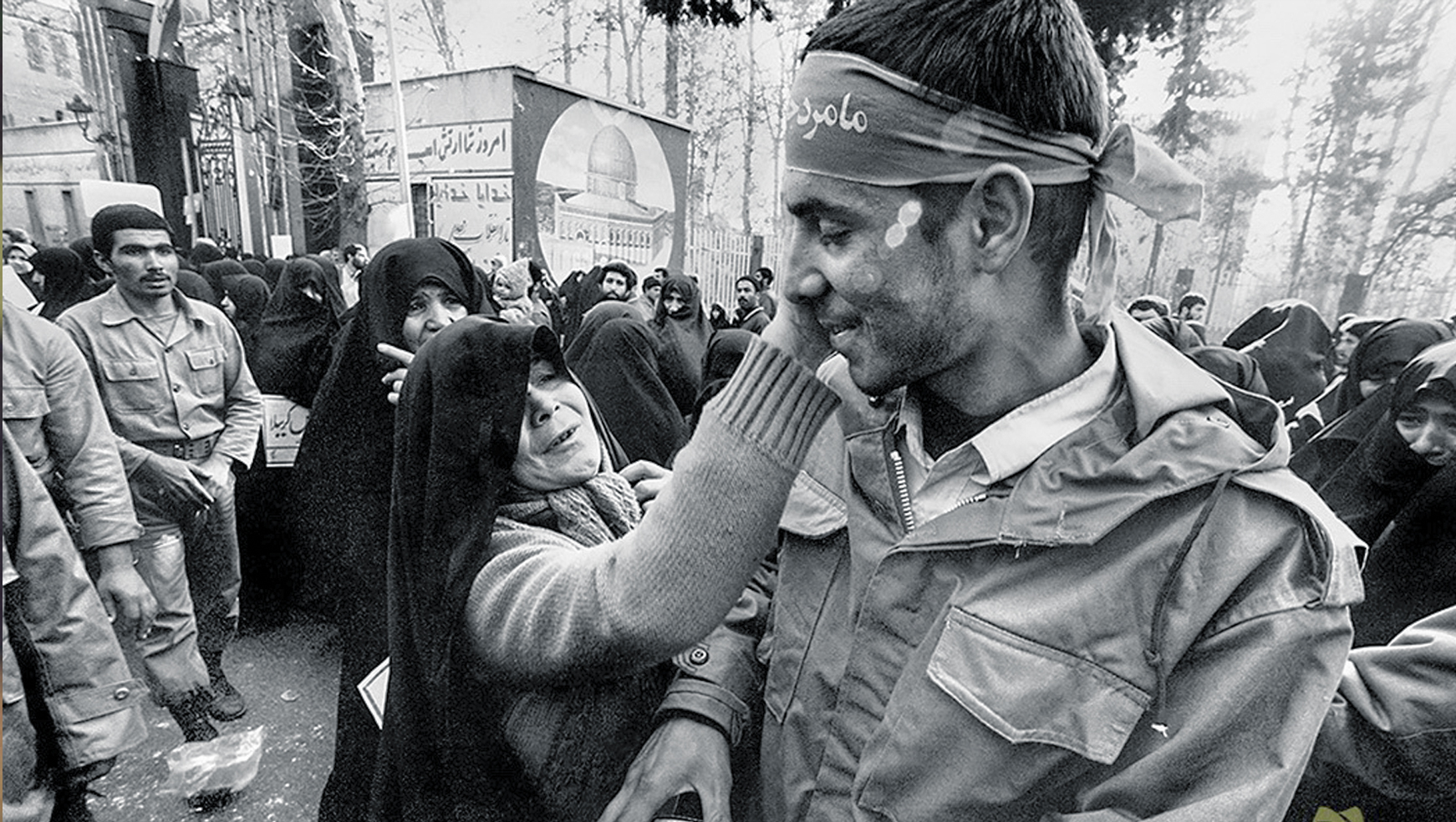
In these generally ideologically stricken narratives, women’s stories and actions matter insofar as they manifest their commitment to the “culture of seeking martyrdom.” Mothers, wives, and sisters are praiseworthy as they not only gracefully welcome the martyrdom of their loved ones but also actively encourage them to join the fronts and seek martyrdom. Morteza Sargangi’s words below, published in an issue of Sureh-ye Mehr magazine allocated to women’s memoirs, sums this view:
In defensive wars, men’s resistance is tied to women’s resistance. If women stop resisting, men’s morale will collapse. This is why I believe that Saddam was defeated by Iranian mothers not by our artillery and tanks. It was the Iranian mothers who packed their children’s bags and send off their husbands to the front.[14]
Women Memoirs
One of the most celebrated and advertised ‘sacred defense’ books that epitomizes this genre is Nāmehāy-e Fahimeh (Fahimeh’s letters).[15] The book, which claims to be an endeavor “for depicting a more complete image of women during the eight years of defense,” features Fahimeh’s letters to her first and second husbands both of whom were killed in combat. The prologue to the book resorts to a tantalizing and emotive language to praise Fahimeh’s commitment to martyrdom. It describes her as a seventeen-year-old student who marries Gholamreza while knowing that he will be martyred soon and that their life together will be short. When Fahimeh and Gholamreza go to Khomeini so he would perform their marriage ceremony (ʿaqd-e ezdevāj), she tells Khomeini that her positive answer is conditional upon him praying for the couple’s martyrdom. When Gholamreza is killed in war, Fahimeh does not mourn. She instead leads the funeral procession shouting out “O’ my martyred husband, congratulations upon your martyrdom…” Fahimeh later marries her late husband’s brother but shortly after she encourages him to go to the fronts. She says, “I am embarrassed that all these [youth] are at the fronts and you are here [at home].”
The ideological lines pushed through these narratives promote with the official presentations of and expectations from families of martyrs encapsulated in the Supreme Leader’s speech below:
*****Never did we, during the eight years of the sacred defense and after it, heard any complaints from the mothers, on the contrary, we found mothers to be even more heroic than many fathers. I have had the honor of sitting with some families of martyrs...and speaking to them in earnest… I do not recall even a single incident – perhaps amongst thousands of cases – that a mother complains about the martyrdom of her son. On the contrary, mothers are proud, they feel they can stand tall.[16]
Shirin Saeidi, who has focused in her fieldwork in Iran on the wives and daughters of martyrs, points out the state’s selective approach with regard to women’s [and that is selected groups of women] experiences of the war. In this context, it is not only ‘whose story is narrated’ but also ‘which segment of one’s story is told’. Saeidi states that the problems that many martyrs’ wives faced after the passing of their husbands are completely absent in the official narratives. In her words, “they would not tell [you] what happened to a fifteen-year-old woman with a child [after her husband’s death]”.[17]
The second category, which is a more recent phenomenon, also remains highly ideological. Unlike the first category, however, it features female protagonists whose stories do not revolve around men. In other words, it is them and their choices and actions that are under the spotlight and not them as mothers or wives. In recent years some memoirs of this nature have been reported to be among the best sellers of war-related literature. Dā: Memoirs of Seyyedeh Zahra Hosseini, as Recorded by Seyyedeh A‘zam Hosseini, published in 2008, is the most prominent example. Dā, narrates the story of 17-year-old Zahra Hosseini in the immediate aftermath of the Iraqi invasion when she, along with her sister, volunteers in a cemetery to wash and bury those killed in Khorramshahr. Later, she also joins other volunteers to aid the wounded and take food and other goods to the front line. Three weeks into the war, she is wounded and is transferred to Tehran for medical care. Other examples of this genre include Maryam’s Boots: Memoirs of Maryam Amjadi as Recorded by Fariba Taleshpour, and OPD Girls: the Memoirs of Mina Kamai as Recorded by Leila Mohammadi. Both books recount the memories of two teenage girls from the cities of Khorramshahr and Abadan in the aftermath of the Iraqi invasion. Just like Zahra, both women decide to stay behind to defend the city against the Iraqi forces. While Mina volunteers in OPD Hospital as an aid worker caring for the wounded, Maryam (in addition to nursing) acts as an armed guard for the ammunition storage in Khorramshahr’s Masjed Jāmʿe (the headquarters of the resisting forces at the onset of the war). At times, she also takes up arms along with a group of armed combatants to defend the fronts.[18]
These memoirs, as Laetitia Nanquette in her study of Dā demonstrates, have benefited greatly from the state’s “propaganda machine” which has aggressively pushed them, both culturally and financially, to attract a larger audience that includes those typically not interested in ‘sacred defence’ literature.[19] It is not surprising therefore that the narratives presented in these memoirs do not stray outside the official line. All protagonists, with varying degrees, adopt and promote the official and heavily ideological discourse of the state on the war as well as on religion, martyrdom, and internal and external ‘enemies’. In this regard, the rationale of Zahra Hosseini for agreeing, despite her previous refusal, to have her memoir written is revealing:
****But the time became as such that those who had sacrificed everything for protecting this land and the sacred Islamic Republic were accused of being warmongers. It was at this juncture that I became adamant to defend our sacred defence and this was not possible except through writing the realities and recording the memories of those days.[20]
Cinema
Similar to literature, war-related cinema has also witnessed a proliferation of stories with increased focus on women. In recent years there has been a shift from ‘front’ to ‘home’ while a number of productions have also focused on women in/near the front. In this article, I do not mean to provide a comprehensive review of all productions that have focused on women or argue that there exists no example of movies (such as Gilaneh) where portrayal of women’s experiences of the war has not fully be within the state’s framework. War-related narratives and productions including films have not remained fully monolithic over the past four decades and the scene has undoubtedly seen some level of contestations and critical voices, albeit confined within certain parameters. What I aim to point at in this article is a pattern in state-produced and state-approved productions, which I believe, in a preemptive manner, write women into the war narrative and have increasingly been celebrated as attentive to previously neglected areas. An example of such production, celebrated as a “a feminine movie” and “feminine experience of the war” has been Vilāyihā (Villa Dwellers), directed in 2017 by Monir Gheidi. The film was praised by state officials including the Supreme Leader for the treatment of previously neglected areas of the ‘sacred defense’.
Vilāyihā portrays the lives of wives and children of war commanders living in villa blocks close to the front. The story starts with Aziz, a woman whose son is fighting at the front, arriving at the villas with her two very young grandchildren. Soon after she settles in one of the flats, Sima, her daughter in law, without whose permission she had taken the children, arrives at the villas. Sima is furious that Aziz has taken her children without her permission to a zone of danger. Her attempt at leaving the area with her children immediately is however halted as Aziz gets so upset at the prospect of them leaving that she passes out. Sima stays and we get a window into the lives of these women, among whom is Mrs. Kheiri, the de facto commander of the villa dwellers and a woman who does not appear to deviate even an inch from the state-endorsed and promoted beliefs and ideologies on the war.
From the onset, Sima appears to be different. Unlike every other woman living in the villas, she does not wear the chador thus indicating a potentially more secular worldview. She also questions the sensibility of bringing young children so close to the front where they face constant risk of attacks. In one of her early dialogues, where we hear her critical voice, Mrs. Keiri offers Sima a radish from her garden telling her that she would not be able to find such a harvest anywhere in the world. Sima, who wishes to leave the country with her children, agrees and responds that yes, “the land is great'' but are “its circumstances also suitable?” However, as the plot progresses and Sima stays with the women residents of the villas who keep receiving the news of the death of their husbands at the front, her opposition starts to fade away. The movie shows at least two scenes of aerial attacks. Filmed from above, we see the women in their chadors running with their children through an open field towards a shelter. Despite the horrors of these attacks and the close encounter Sima and her children have with death, in the final scene, Sima alters her decision to leave until the children see their father who is at the front. Sima is no longer the polar opposite of Mrs. Kheiri, as portrayed at the start of the film, and can easily be perceived as her replacement when the latter leaves the compound after the death of her husband. These women are not brought closer to each other in compassion and developing a mutual understanding. Rather, it seems it is Sima who has come to understand and accept what is considered to be the higher moral stand of the other women.
The issues around representation of women in war-related cinema and other cultural productions in Iran is not limited to ‘whose story is told’ and ‘which selected part of these selected women’s stories is narrated’, but the severance of their stories from other sociopolitical contexts. Women did not experience the war in a vacuum. Their experiences of the war were interwoven with their experiences of state repression and violence including at the hands of the society. I believe that a rare example of a cultural production that directly deals with the Iran-Iraq war outside of the usual parameters that have governed ware related movies and succeeds to place a woman’s story amid the broader context of violence is “Under the Shadow” directed by Babak Anvari, outside of Iran.
Under the Shadow’s storyline is centered around a young mother, Shideh and her daughter, Dorsa who lives under the horrors of the final stages of the Iran-Iraq War when the ‘War of the Cities’ devastated the civilian population of both countries. The film starts with a well-known wartime anthemic music loudly played in the hallways of a university. We then see Shideh, who is a former medical student, cladded in a massive maghnaeh sitting anxiously in a meeting with a university official discussing the possibility of her resuming her education. The official, blatantly tells Shideh, who used to be politically active at university during or post 1979 Revolution and thus a victim of the Cultural Revolution’s cleansing’, that “mistake have consequences” and she must therefore get the thought of ever resuming her studies out of her head. Shideh, devastated and infuriated, returns home, bags all her medical textbooks, bar one, to chuck them away. She locks the only book she has kept, a medical textbook that her mother gave her as a gift, in a drawer and hides the key.
Soon after, Iraj, Shideh’s husband, a doctor, who we learn later, had stayed away from politics during his studies and was able to finish his degree and leaves the apartment for the front. He is summoned and as a doctor, he sees no option but to respond to the drafting letter in order to keep his medical license. He asks Shideh to take Dorsa and say with his family in northern Iran, but Shideh refuses to leave her home.
What follows is horror: a missile pierces the ceiling of the building where Shideh and Dorsa live. It does not explode, rather it carries and lets loose in the building and the lives of its residents demons. After the arrival of the missile Dorsa, who unlike Shideh sees the demons, loses her beloved doll, Kimia. She anxiously and with a fever that does not disappear searches for Kimia. As sirens dominate the daily lives of the residents, the building, which stands as a metaphor for wartime Tehran, gradually empties of its residence. But Dorsa refuses to leave without her doll, Kimia. Mother and daughter, both of whom are now haunted by demons, are now left on their own.
Ultimately Shideh finds Kimia in the locked drawer where she had kept her medical book. Kimia is mutilated. Shideh and Dorsa eventually overcome the demons and flee the haunted building. They are seen driving away from Tehran to the north of the country. In the back seat, Kimia the doll is lying headless. There may be fleeing from the haunted house and the city but no one can escape unscathed. Dorsa’s childhood is injured and scarred by the war.
The film intelligently chooses the genre of horror in order to convey the trauma and horrors of the war and the devastation of the civilian population through paranormal elements. Within these horrors experienced by all civilians, the movie tells the story of a woman not just living under the shadow of a war but experiencing the war as a dissident woman whose integrity, choices and rights are also attacked and oppressed by the state and in a patriarchal society which largely fails to stand in solidarity with her. Shideh is stripped of her right to education because of her political views and activism. Her husband, who has been able to continue his education, tries to console her by saying that “it might be for the best ''. As the only woman who drives in the building, she is blamed by the conservative landlord for leaving the garage’s doors open and making the building vulnerable to ills. And when she flees the horrors of the war by holding Dorsa and taking refuge in the street, she is arrested and humiliated for having failed to wear the appropriate compulsory hejab. For this reason, she carefully closes the tick curtains of her flat when she works out with the banned VCR tapes of Jane Fonda videos. Under the Shadow therefore tells the story of a woman who deals with bombs and horros of the war amid the state’s attempts to erase her independent mind and her body from the public space.
Some may argue that the mere proliferation of representation of women in war-related cultural productions and the presence of women who dissent, even if slightly and for a short-while, could ultimately create cracks in the hegemonic power of the state over war narratives and allow for the emergence of voices that are not fully and mainly directed by the state. While such arguments need to be further explored, I believe that the tactful coverage of previously neglected issues through narratives that are generally and deeply embedded within the state discourse on the war, ultimately aim to neutralise and suppress the subversive and radical potential of counter memories and histories that arise as a result of the emergence of the absent voices.
[1] Shahram Chubin and Charles Tripp, Iran and Iraq at War, (London, I.B. Tauris, 1988), 70.
[2] Erich J. C. Hahn, “The German Foreign Ministry and the Question of War Guilt in 1918-1919,” in German Nationalism and the European Response, 1890-1945, ed. Carole Fink, Isabel V. Hull, and MacGregor Knox, (Norman, OK, 1985): 43–70, 47.
[3] Katharina Rietzler, “The War as History: Writing the Economic and Social History of the First World War”, Diplomatic History, Volume 38, Issue 4, (1 September 2014): 826–839, 831.
[4] Christiane Gruber, “The Martyrs’ Museum in Tehran: Visualizing Memory in Post Revolutionary Iran” Visual Anthropology, Vol. 25, no. 1-2 (2012): 68-97, 85.
[5] Ibid., 85.
[6] Patricia Leavy, Oral History: Understanding Qualitative Research (Oxford University Press, 2011), 6.
[7] Ibid., 6.
[8] Jacquelyn Dowd Hall, “Documenting Diversity: The Southern Experience”, The Oral History Review, Volume 4, Issue 1 (1976):19–28, 19.
[10] Miriam Cooke, Women and the War Story (Berkeley, CA: University of California Press, 1997), 293.
[11] Ibid., 296.
[12] Ibid., 296.
[13] Gholamreza Jamshidiha and Nafiseh Hamidi, “Tajrobeh-ye zanāneh az jang”, Pazhuhesh-e Zanān, 5(2), (2007): 81-108, 89.
[14] Morteza Sarhangi, “moqāvemat-e jānāneh zanān-e sarzaminemān,” Mehr, Issue 235, 23 July 2015.
[15] Fahimeh Babaianpour, Nāmehāy-e Fahimeh beh ehtemāme Alireza Kamari, (Sureh-ye Mehr, 2017).
[16] Khamenei.ir, “bayānāt dar didār bā ʿavāmel-e tolid-e film-e sinamāyi-e shiār-e 143”, 1.
[17] Maryam Hosseinkhah, “Ravāyat-e nāshenideh-ye zanān az jang”, BBC Persian, 27 September 2010, accessed on 7 March 2018, <http://bbc.in/2FgFOUc>
[18] Maryam Amjadi, Putinhāy-e Maryam: khāterāt-e Maryam Amjadi, mosāhebeh va tadvin Fariba Taleshpour, (Sureh-ye Mehr 2011) and Mina Kamai, Dokhtarān-e o.pi.di: khāterāt-e Mina Kamai, mosāhebeh va tadvin Leila Mohammadi, (Sureh-ye Mehr, 2007)
[19] Laetitia Nanquette, “An Iranian Woman's Memoir on the Iran–Iraq War: the Production and Reception of Da," Iranian Studies, 46, no. 6 (2013): 943-57, 957.
[20] Seyyedeh Zahra Hosseini, Dā: khāterāt-e Seyyedeh Zahra Hosseini beh ehtemāme SeyyedehʿAzam Hosseini, 73ed ed. (Sureh-ye Mehr 2009/2010), 11.