

17 February 2026
Fragments from the Protests: Voices from Several Cities
Tehran — 8 Bahman (28th January)
A friend who was released yesterday sent me a message. “I feel ashamed I got out of that hell,” he wrote. “My friends are still there. They put us through all kinds of staged executions. They tried to strangle me with wire. They pulled a plastic bag over my head. They pressed an unloaded gun to my head and pulled the trigger. They shocked my chest. They poured cold water over me in a cell with no heat. They insulted me with the most vile words. “I hope something happens soon. Even one of these things is crushing. And the ones they filmed… they had to endure all of it.”
Tehran — 18 Dey (8th January)
Around seven in the evening, I went to Haft-e Tir Square. The area was unusually quiet. The street vendors who usually fill the sidewalks late into the night were nowhere to be seen. There were fewer cars than on a normal day.
A handful of people wandered along Karim Khan in small groups of two or three, circling without a clear destination. Some wore masks. Nearly half were women and young girls.
At the north end of Haft-e Tir, near the metro entrance, a small crowd had formed and was chanting. Off to one side, about twenty or thirty security forces stood near a cluster of motorcycles. In front of Al-Javad Mosque on the eastern edge of the square, another group waited — not in uniform, some in camouflage, carrying shields and batons.
As eight o’clock approached, more people began to appear, pouring in from alleyways and side streets, like streams feeding into a wide river. Within minutes, the empty streets filled with crowds of people. Everyone moved toward the Karim Khan overpass.
Under the bridge, the crowd thickened until there was barely room to breathe. Voices rose from every direction. One chant collided with another. “Death to the dictator,” someone shouted. Elsewhere, a different slogan answered back. The noise was chaotic, but the emotion was unmistakable: anger, raw and overflowing.
Then a chant suddenly swallowed the space beneath the bridge — it spread fast, repeated in waves, as if the crowd had found a single pulse.
The sound of riot police motorcycles cut through the air and, for a moment, the crowd fell silent. Then people began chanting again — not led by anyone, just instinctively, as if the street itself had learned to speak.
That was when I heard gunfire.
Tear gas followed. People surged toward Mirza-ye Shirazi and Iran-Shahr, fleeing the choking smoke. Some shouted, “Don’t run! Stay together!” But the crowd moved like a tide, pushed east, then west, then back again.
The gas filled everything. Streets and alleys clogged. The chants grew more unified — and then, above us, a group of motorcyclists appeared on the bridge and fired more tear gas down into the crowd. People scattered, regrouped, returned. No one stood still. Everyone kept moving, as if stopping would make you an easy target.
My eyes burned. A middle-aged man lit a cigarette and said, “Breathe in the smoke — it helps.” I knew it didn’t, but he insisted, his masked face stubborn with urgency.
A little farther ahead, a young woman in a black beanie was sitting on the sidewalk near a shop on Iran-Shahr, surrounded by people trying to help. A man pulled a bottle of water from his backpack and handed it over. “Rinse her eyes,” he said. “It’ll ease the pain. And get her somewhere quieter.”
But there was no quiet. The crowd kept shifting, nudging, carrying you along without asking.
Then my friend and his brother arrived. Tears ran down all our faces. Nearby, people shoved a large trash bin into the middle of the street. A young man set the papers inside on fire, hoping the smoke might dull the sting in people’s eyes and throats.
We stepped away from the densest part of the crowd, but people still streamed up and down Iran-Shahr. A few streets lower, we got into a car and drove toward Enghelab.
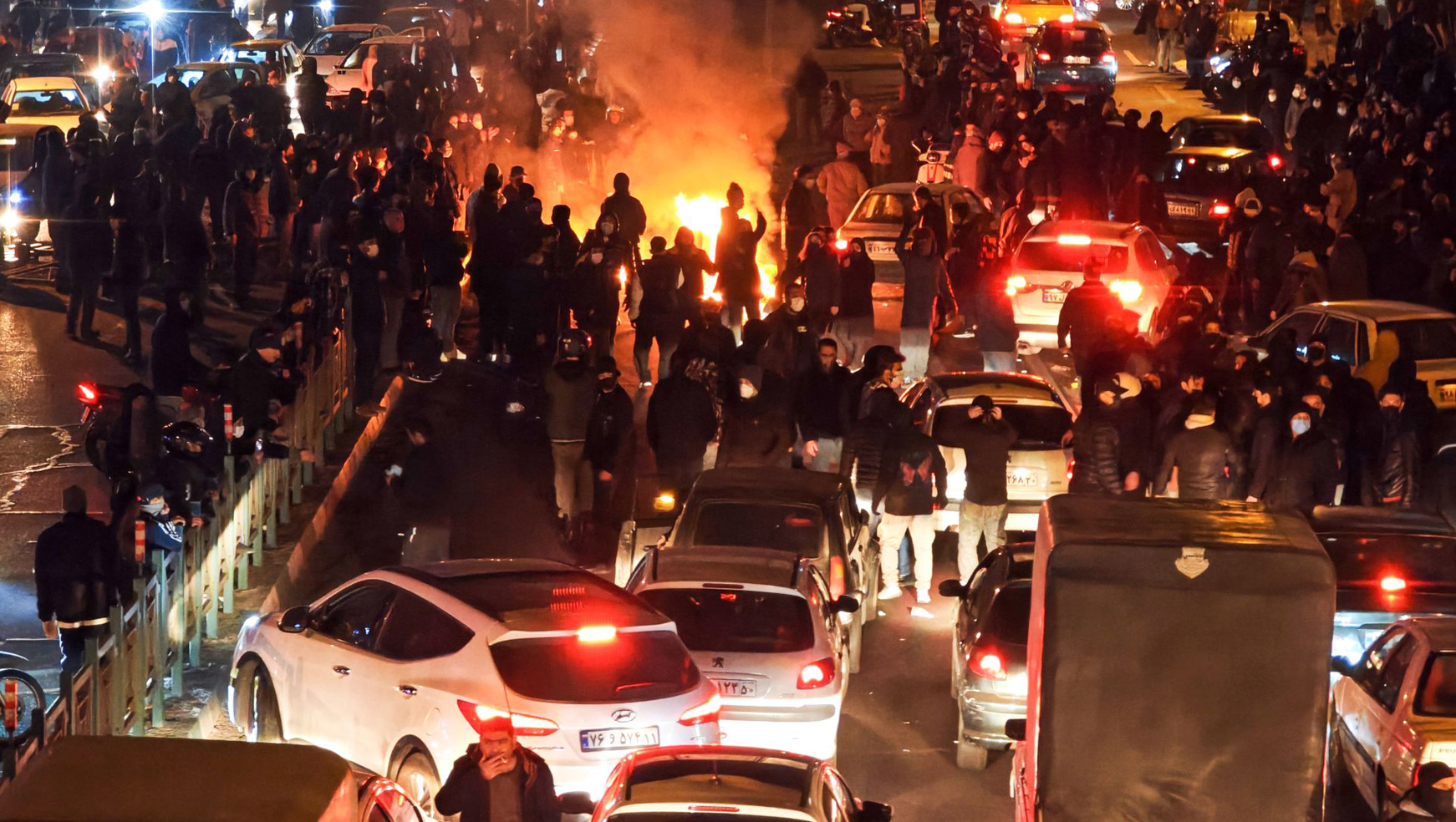
The streets felt like they belonged to the protesters. Fires burned on corners. As we moved east toward Enghelab Square, the crowds grew larger. From far away, I could see flames. Many of the big roadside trash bins had been dragged into the road and were now burning. At several points we had to pass through heat and smoke to keep going.
Metal barriers had been torn out and used to block the road, stopping riot police motorcycles from charging into the crowd.
The main road toward Azadi was closed, so we tried side streets — but everywhere was full of people. It was hard to believe. I can’t remember ever seeing Tehran like this: so furious, so crowded.
A route that should have taken twenty minutes took an hour. We reached a friend’s home near Enghelab. He has lived there for eight years. “I’ve never seen a crowd like this,” he said. “Not even at the height of Woman, Life, Freedom.”
He told us that earlier, as the chants grew louder, the loudspeaker installed by the municipality — the one that usually broadcasts the call to prayer — suddenly switched on and began playing mourning chants to drown out people's chants.
We stayed inside for a while. The sound of gunfire came in bursts.
Later we went back out and drove toward Sadeghieh. It was close to midnight. Around the square, three vans and another vehicle were burned. In the middle of the square, a small group of riot police — maybe fifteen or twenty — sat on the ground, looking like a defeated unit after a lost battle.
Small groups of protesters walked quickly nearby, masked, some wearing black beanies. The next day, a friend told me that one of his colleagues had been shot from behind with live ammunition in Sadeghieh and killed.
The internet had been completely cut since seven p.m. Phone lines, too, were down for hours. No one could reach anyone. We were blind inside our own city.
Tehran — 19 Dey (9th January)
The next morning, the streets had been scrubbed clean. No trace of smoke, no ash, no burnt debris. The Islamic Republic is an expert in clean-up — not only of streets, but of evidence.
The torn-up barriers were gone. The burned bins had been removed. Around Enghelab and Haft-e Tir, Friday was quieter than usual. You wouldn’t know anything had happened the night before.
We couldn’t send texts to one another — yet messages from law enforcement and security agencies appeared on phones, telling families to control their young people. Police announced they would show “no leniency” and called on parents to watch their “youth and teenagers.”
State television played triumphant religious music and looped images of damage from the night before, calling protesters agents of Israel and the United States. With the internet shut down, there were little or no real footage and first-hand reports. But everything we could piece together — satellite channels, scattered testimony, what we had seen with our own eyes — pointed to something larger than a single night of protests: one of the biggest nationwide uprisings against the Islamic Republic.
By about eight in the evening, near the Haft-e Tir metro entrance toward Karim Khan, small groups wandered again — masked, wearing beanies, walking without an obvious direction. The street felt emptier than the night before. Every shop was closed. No vendors. No usual bustle.
There were no visible riot police in the immediate area. But when we turned toward Mofatteh, heading north, riot police and their motorcycles stood outside Al-Javad Mosque. We changed direction, back toward the Karim Khan overpass. Under the bridge, people had gathered again. On Iran-Shahr, a group chanted, but from the top of the street you couldn’t move downward — the crowd blocked the way.
We drove toward Sohrevardi. At the corner of Bahar, protesters had gathered and were chanting. Along the sidewalk, small clusters moved in the same restless pattern — walking, stopping, starting again. The streets were almost empty of cars. Even the main highways through central, east, and west Tehran were unusually quiet.
From the Yadegar Bridge above Sattar Khan, we could see heavy smoke. As we approached, we heard chants. A large number of riot police stood on the bridge firing tear gas down toward Sattar Khan. It seemed that street was packed again, like the night before.
We drove around the city to understand what was happening. The streets around Sadeghieh were crowded. Protesters’ shouts rose from every direction. In Punak, roads were blocked and movement was nearly impossible; the crowd was chanting.
The internet and phones were still down. No one knew what was happening in other neighbourhoods, let alone other cities. Anxiety grew by the hour. It felt like being thrown back a century — into a time when the only news you had was what you saw yourself, or what you heard from a neighbour.
State TV and satellite channels hinted at a bloody crackdown. But without communication, rumours multiplied and certainty disappeared.
In the days that followed, news arrived slowly, like delayed thunder. It became clear that the whole country had risen at once. Friends in Rasht, Gorgan, Semnan, Shiraz, Mashhad, Tabriz — all said the same thing: We have never seen crowds like this. We have never seen violence like this.
Rasht
As soon as the phones briefly came back, Ali called with news of a massive fire in Rasht’s bazaar. He said many shops had been destroyed completely.
According to what he heard, the fire began on the afternoon of 18 Dey (8th January), when protesters entered the market, and continued until the morning of the 19th. More than 400 shops — in sections known as the Big Taaghi, Small Taaghi, Fakhr Qeysarieh, the booksellers’ bazaar, and Saray-e Malek — were reduced to ash.
He said protesters tried to let fire trucks reach the area, but security forces blocked firefighters from entering.
Some reports suggested Rasht was among the bloodiest sites of protest — but with the internet cut and families terrified into silence, no reliable numbers emerged.
Sari
A doctor in one of Sari’s hospitals said the staff had been put on alert before the night of 18 Dey. (8th January). “That night, we had thirty dead in our hospital,” he told me.
The wounded begged to be admitted anonymously. Security forces were present in the hospital, clashing repeatedly with doctors and nurses.
“When I left,” he said, “I was so shaken I cried for three or four hours without stopping.”
Sari has several hospitals of similar size, he added. “I’m afraid to imagine it was like this everywhere.”
Chalus
In Chalus, large crowds came out on the night of 18 Dey (8th January). An eyewitness said security forces opened fire directly on protesters in the street. Some residents spoke of twenty to thirty deaths.
Mehrnoush said she personally knew two people who had been shot and visited them afterward: one wounded in the abdomen, the other in the leg. Both were treated quickly and taken home immediately — terrified they would be arrested if they stayed in hospital.
One of them, a sixty-year-old man, described what happened: “The Basij fired straight at us. I was hit. The bullet went in one side of my leg and out the other. I was lucky it was my leg — otherwise I’d be dead, like the others. I saw several people shot in the head die right in front of me.”
He said he heard at the hospital that twenty-one protesters had been killed in Chalus.
His condition was not good. A doctor who visited him at home suspected a fracture and insisted on an X-ray. That evening, the doctor drove him — along with two others — to a radiology clinic that had agreed to see them quietly. The result showed a severe break. For now, the only option was a cast.
The family of a young man who was killed, identified his body at the forensic office — but authorities refused to release it for burial. They told the family they would “call later.” Three days passed. On the fourth morning, at six am, they received a call: come collect the body.
They rushed there, hoping to take him back to their village. Instead, security agents told them they had one hour — to bury him right there.
A hospital employee in Chalus said that on the first night of protests, from around ten pm until morning, the hospital was overwhelmed with the wounded and the dead. “I saw it with my own eyes,” he said. “Many were already dead when they arrived. Others died in the hospital.”
Since then, he said, he can’t sleep. “As soon as I drift off, I wake up hearing screams.” What he witnessed felt like the end of the world — like a makeshift field hospital in a war zone.
Nowshahr
Hamed, a protester in Nowshahr, described what happened on the night of 18 Dey (8th January) on Ghodrati Street. “All of a sudden, they started shooting directly at us, right in the middle of the street,” he said.
A large crowd had gathered when riot police arrived by car and motorcycle and began firing. “Several people fell in front of me.”
Hamed fled south with a group of protesters into nearby rice fields. There were thirty or forty of them, including a few young women. They could still hear gunfire. Everyone was terrified.
“We cursed ourselves,” he said. “But what could we do? We had to get out.”
They climbed over walls until a resident of a nearby apartment complex noticed them and opened the door. They hid inside for about two hours. When things calmed down, they left one by one.
A hospital worker explained why fewer wounded people were taken to the hospital this time. During the Woman, Life, Freedom protests three years ago, security forces had opened cases even against injured protesters. Now people were avoiding hospitals and being treated in “safe” places instead — often with minimal equipment, by doctors who were taking real risks.
The fear of arrest was shaping medical care, and it could cost lives.
Andimeshk
Two weeks after the protests, Soroush came from Andimeshk and told me what he had seen — scenes he still struggled to believe.
On 18 Dey (8th January), the protests there passed without major clashes. Tear gas was fired, but there were no reports of live bullets or deaths. The next day, everything changed. By late afternoon on the 19th Dey (9th January), the streets of that small city looked like a battlefield.
Soroush said he saw the bodies of twelve young people in the city’s only hospital — protesters who had been wounded and died after being brought in.
“You don’t understand what it was like,” he kept saying, shaking his head. “They were shooting directly at people.”
He described one moment in particular: a masked security officer approached a protester, pressed a shotgun to his back, and fired. The young man collapsed. People stepped back in shock. The officer then stepped on the injured man’s chest with his boot — until the victim’s friends attacked the officer and others rushed in. The security forces retreated.
The wounded protester was unconscious, a hole torn into his back. His friends carried him on a motorcycle to the hospital. Doctors removed part of his lung. Somehow, he survived. But security forces were roaming the hospital, questioning anyone near the injured, taking names and addresses.
After ten days and multiple surgeries, an X-ray showed the remaining lung still filled with pellets. “There’s nothing more we can do,” the doctor told them. The pellets were lodged like shrapnel. His life would not return to normal.
Soroush also heard another story from a resident: a little boy, next door, drawn by noise, stepped outside his home with a woman, probably her mother. They stood by the doorway, watching the street. Suddenly, a burst of gunfire began. Before either could move, both were hit by live rounds and killed on the spot.